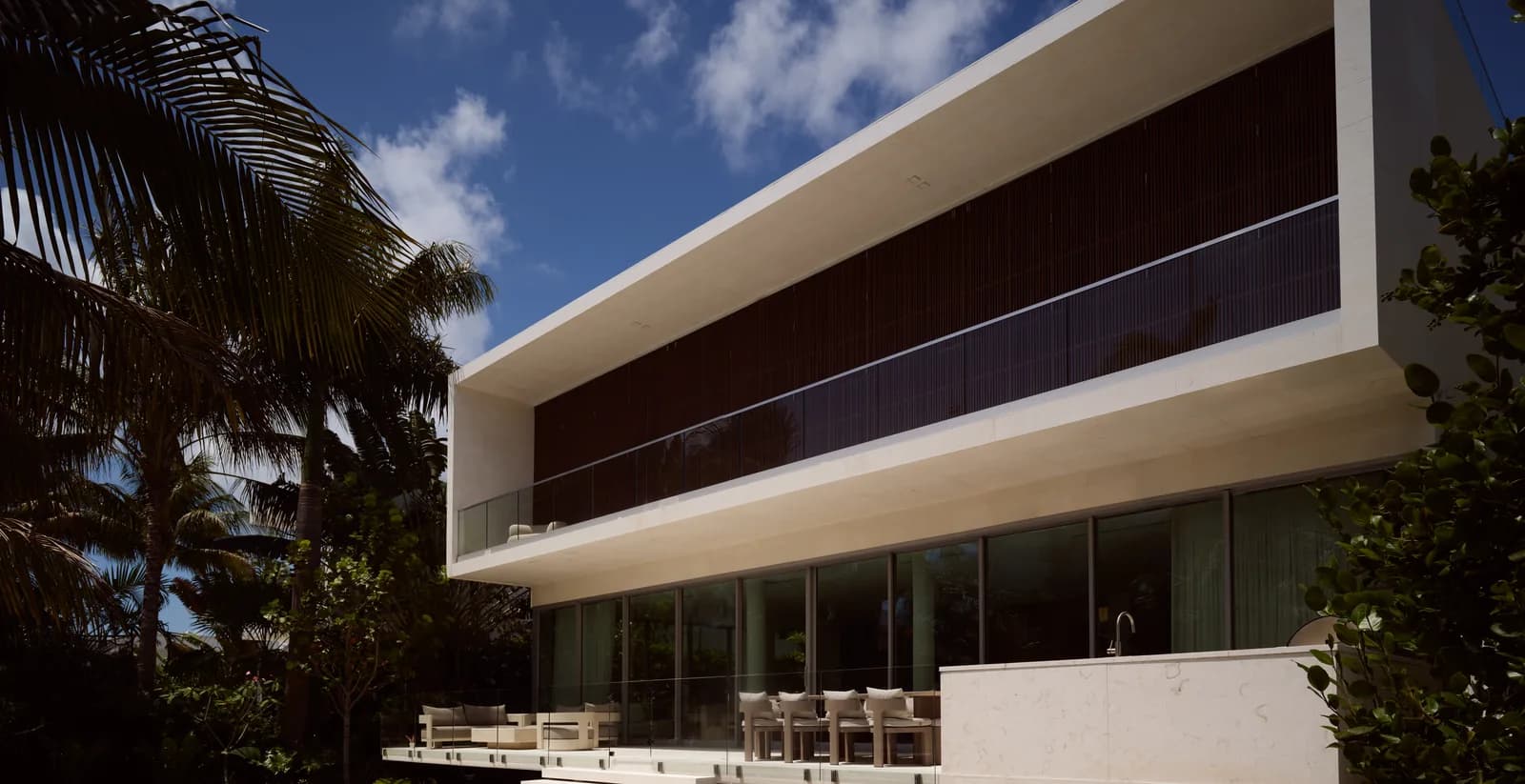
An $8.2M development cost breakdown, from land to finish
How a luxury development budget at this scale divides across land, architecture, construction and finishes: the categories, the logic behind each one, and what they mean for a buyer.
Luxom Studio · LUXOM Developments
· 7 min read · Last reviewed
Key takeaways
- Land is the first and largest category in a luxury development budget, typically 30 to 40 percent of total cost in Coconut Grove, and the only decision that cannot be revisited once it is made.
- Architecture and engineering are not overhead: they are the document set that makes every downstream cost predictable and protects the schedule at permitting.
- Construction in Miami carries structural requirements that add cost and protect the asset. Wind engineering, impact glazing and flood elevation compliance are real line items that reflect in the total number.
- Finishes are where a buyer forms their perception of value and where long-term resale is protected. The same budget concentrated on finish returns more at sale than the same spend on raw square footage.
- Soft costs and contingency are predictable. A well-run project budgets 10 to 12 percent for permits, fees, financing carry and reserve before work begins.
From the developer
People ask about the $8.2M figure before they ask what built it. The number is real and it comes from a specific project budget, spread across categories that each reflect a deliberate decision about where value should live in the finished home.
A development budget at this level is not a single cost. It is a composition: land, architecture and engineering, construction, finishes, soft costs and the contingency that protects the schedule when the unexpected arrives. Understanding the breakdown is the first step toward understanding what the number actually bought.
The land is the decision that cannot be revisited once it is made
Before a single drawing is made, the land acquisition sets the ceiling, the floor and the character of everything that follows.
Land: the first and largest line
In Coconut Grove, land is not where you negotiate the budget down. A premium lot in the Grove, the kind that earns the home built on it, represents 30 to 40 percent of the total development cost at the $8M-plus level. That is the largest single category in the budget and the only one with no course-correction available after closing.
The block determines the neighborhood floor under the home's value. Proximity to the water, the canopy overhead, the quiet of the street and the neighbors around it: those are fixed. They hold value when the market softens in a way that design and finish cannot. A great house on the wrong site is a compromise from the day the ink dries. A considered site gives every subsequent decision room to add to, rather than compensate for, the location.
This is the reason acquisition receives the most disciplined analysis of any phase in a LUXOM development. We are not acquiring land to build a house. We are acquiring the context that justifies everything the house will cost. That argument is made at length in Where luxury developers actually make money.
Architecture and engineering
Architecture and engineering typically account for 5 to 7 percent of a total development budget at this scale, or roughly $410,000 to $575,000 on an $8.2M project. The range depends on design complexity, the number of consultants required and the depth of engineering coordination.
That fee buys more than drawings. It buys the document set that governs everything downstream: the structural integrity of the building, the coordination of all systems before any wall is closed, the permitting submissions that have to hold up under plan review in one of the most demanding building jurisdictions in the country. A complete, coordinated set of construction documents is the single greatest protection against cost overruns and schedule delays during the build.
The projects that overspend on construction almost always underspent on design. Decisions left open in the drawings get made on-site under pressure, and field decisions cost three to five times what they would have cost in the design phase. Architecture and engineering are not overhead in a development budget. They are the mechanism that controls every other line.
That is also why this category never appears as a separate invoice line on a Luxom project: the fee is the studio's own work, not a bill from an outside firm. We unpack exactly where that cost goes in design is the cost you never see on the invoice.
Construction: structure, envelope, systems
The build itself, the concrete, the framing, the mechanical, electrical and plumbing systems, and the envelope that ties them into a weathertight shell, is the technical core of the project and the category most shaped by Miami-specific requirements.
Construction of the structure typically represents 35 to 40 percent of a total development budget at this scale, covering everything from foundation to a completed, inspection-ready shell ready for finishes. In the Miami luxury market, construction runs from $300 to well above $500 per square foot depending on specification level and complexity.
Three cost drivers are real and cannot be engineered around. First, the Florida Building Code imposes wind load engineering that shapes every structural member and fastener in the building. Second, impact-rated glazing is required on all exposed openings and carries a significant premium over standard glass. Third, flood elevation requirements, common across Coconut Grove and much of Miami, dictate how high the finished floor must sit above grade, adding fill, foundation work and site engineering that would not appear on a comparable project in a mild-climate market.
These are not overruns. They are line items, and they are also what makes a Miami home built to last. The same climate that drives the requirements punishes buildings that do not meet them.
Pull quote
A cost breakdown is not a transparency exercise. It is a map of where the value was built and what protects it at resale.
Finishes: where the budget becomes a home
The structure produces a sound, weathertight building. The finishes make it a LUXOM home. Stone, millwork, cabinetry, flooring, lighting, plumbing fixtures and landscape together account for 15 to 22 percent of the total development budget at this level, roughly $1.2M to $1.8M on an $8.2M project. That is not a luxury indulgence. It is the category with the highest return at resale and the one that dates fastest when it is compromised.
Real stone quarried and cut to dimension, not porcelain printed to resemble it. Millwork fabricated for the specific room it occupies, not assembled from a standard catalog. A kitchen where the proportions were drawn, not selected from a manufacturer's layout. Lighting placed where the light needs to be, not where the junction box was easiest to run. These distinctions are what a serious buyer notices, because they cannot be introduced later without tearing the room apart to do it.
Long lead times are part of the cost of finishes that matter. Specialty stone, custom windows, imported cabinetry and curated landscape materials all require early ordering, careful sequencing and storage management. The projects that run over schedule at the finish stage almost always resolved the structure beautifully and treated finish sourcing as a problem for later. It is not a problem for later.
Soft costs and contingency
Soft costs are the line items that do not appear in the construction contract but are real in every project budget: architecture and engineering fees (covered above), permit and impact fees, title costs, legal, financing carry during the build, project management overhead, inspection fees and the contingency reserve held for items not fully resolved in the drawings.
In a well-managed luxury development at this scale, soft costs and contingency run 10 to 12 percent of the total project budget, or $820,000 to $985,000 on an $8.2M project. The developers who present initial estimates without this category do so for a reason: the budget looks lower before those costs appear. They will appear. The question is whether they were anticipated or absorbed as surprises.
Budgeting soft costs and contingency from the first conversation is one of the clearest markers of a developer who has built this kind of project before. It is also how every LUXOM project is structured.
What the numbers mean for a buyer
Understanding a development cost breakdown changes how you read a price. The $8.2M is not a single decision. It is the sum of six categories, each with its own logic, its own level of post-construction changeability and its own contribution to the home's long-term value.
Land is the floor. Construction is the structure that holds the building in one of the most demanding climates in the country. Finishes are the value that a buyer reads and pays for at sale. Soft costs and contingency are the carrying capacity that holds the project together when the unexpected arrives, and the unexpected always arrives. A development that has been thought through at the category level, with each line budgeted honestly and each decision sequenced correctly, shows in the finished home in ways that are hard to articulate but easy to feel from the moment you walk through.
For the full argument on where value is built and protected, see Where luxury developers actually make money. For the build sequence from land to move-in, Building a custom luxury home in Miami, start to finish covers each phase in detail. The projects page shows the standard, and the contact page is where a serious conversation starts.
Pull quote
A cost breakdown is not a transparency exercise. It is a map of where the value was built and what protects it at resale.
Filed under
Questions about luxury home development cost breakdown Miami
01How much does it cost to build a luxury home in Miami?
The total cost of a luxury home in Miami depends on the site, the specification level and the scope of the design. A fully custom residence in a neighborhood like Coconut Grove is a multi-million dollar commitment before finishes, soft costs and land are added to the construction budget alone. At the $8.2M level, the investment is spread across land acquisition, architecture and engineering, construction of the structure and envelope, finishes and the soft costs that run through every phase. We scope realistic budgets per site and brief; the conversation starts through our contact page.
02What percentage of a luxury development budget goes to land?
In Coconut Grove and comparable Miami neighborhoods, land and site costs typically represent 30 to 40 percent of the total development budget at the $8M-plus tier. That share reflects what the block itself is worth, and it is the most consequential category in the budget because it is the only one you cannot revisit after purchase. The right land in the right location puts a floor under the finished home's value that no finish or design decision can substitute. The fuller argument is in Where luxury developers actually make money.
03What drives construction costs up in a Miami luxury home?
Three forces push construction costs above typical market rates in Miami. First, the Florida Building Code imposes wind engineering requirements, impact-rated glazing standards and structural specifications shaped by decades of hurricane history. Second, flood elevation requirements, common across much of Miami and Coconut Grove, add fill, foundation work and site engineering that do not appear in most other markets. Third, the salt-air and humid climate narrows exterior material choices toward products built for corrosion and moisture resistance, which typically cost more. These are not avoidable: they are what a properly built Miami home requires, and what protects the asset long term. Our services page explains how we engineer for these conditions from the first drawing.
04Why do finishes represent such a large share of a luxury development budget?
In a luxury home, finishes are not decoration added at the end of a project. They are the primary evidence of quality that a buyer reads from the moment they enter the space. Real stone, custom millwork, imported cabinetry, curated lighting and considered landscape are each long-lead decisions that require sourcing, specification and sequencing well before installation. They are also the category that cannot be retroactively added without dismantling what is already built. In a project at the $8.2M level, finishes account for roughly 15 to 22 percent of the total budget, and that share protects the premium at resale more reliably than almost any other line.
05What are soft costs in a luxury development, and how much should I budget for them?
Soft costs are the real project expenses that sit outside the construction contract: architecture and engineering fees, permit and city impact fees, title and legal costs, financing carry during the build, project management, inspections and the contingency reserve for items not fully anticipated at the start. In a well-managed luxury development, soft costs typically run 10 to 12 percent of the total project budget. Developers who omit them from early estimates create the appearance of a lower number that resolves itself as additional invoices arrive mid-project. Budgeting soft costs from day one is a clear sign of experience.
06Where in the budget do luxury developers focus to protect resale value?
The discipline is to concentrate budget on the categories that cannot be changed after the build: the land, the structure and the finishes. Those three are where long-term value lives. You can repaint a room or replace a fixture. You cannot add ceiling height, reposition a structural opening or replace stone that is already set without essentially rebuilding the space. The decisions that are costly to reverse deserve the most attention in the budget. That logic separates a development with lasting value from one that ages against you. Our journal covers this in more detail.
Explore the portfolio
Projects to see


Talk to the studio
If this belongs in your home, our studio will draw the plan.
Initial conversation, 30 minutes. We listen to the brief and respond with a scoped proposal within five working days. You can also read the services page for typical timelines and fees.
Written by Luxom Studio · LUXOM Developments
The design and development studio behind LUXOM residences in Coconut Grove, Miami
Keep reading
From the journal
Development · Jul 8, 2026 · 2 min
Where luxury developers actually make money
It isn't the house. The margin is decided the day you buy the land, and protected by everything you refuse to cheapen.
Development · Jul 23, 2026 · 4 min
Building a custom luxury home in Miami, start to finish
What it takes to build a custom luxury home in Miami, from land and design through permitting and finish. The real sequence, the local constraints, and where a builder earns their keep.
Development · Aug 29, 2026 · 5 min
Design is the cost you never see on the invoice
Every luxury build pays for design somewhere. When one studio designs, builds and finishes the home, that cost never shows up as its own line, it is folded into every dollar spent downstream.